If you live in Kerala or follow Malayalam traditions, you probably plan your year around the Malayalam Calendar. This calendar tells you the right dates for festivals, poojas, fasting days (vrats), and wedding muhurats. In this guide, we have put together the complete Malayalam Calendar 2026 in one place — month names, major Kerala festivals, Ekadashi and vrat dates, and marriage muhurat dates — so you don’t have to search multiple places.
This article is written in simple language so that anyone, whether you are a student, a homemaker, or someone planning a wedding or pooja, can understand and use it easily. All dates given here are based on traditional Malayalam Panchang calculations and are meant for general reference. For very important events like weddings or major religious ceremonies, we always recommend confirming the exact muhurat with a qualified local astrologer or temple priest, since panchang calculations can vary slightly between regions.
Malayalam Calendar 2026 — Month by Month
Below is the full list of Malayalam Calendar 2026 months in English along with their Malayalam names. Each month follows the solar movement of the sun and generally overlaps two Gregorian months.
| Gregorian Month (2026) | Malayalam Name | What It’s Known For |
|---|---|---|
| January | ജനുവരി | Makar Sankranti, Republic Day, Vasant Panchami |
| February | ഫെബ്രുവരി | Thaipusam, Maha Shivaratri |
| March | മാർച്ച് | Holi, Ugadi, Ram Navami |
| April | ഏപ്രിൽ | Vishu (Malayalam New Year), Hanuman Jayanti |
| May | മെയ് | Buddha Purnima, Vat Savitri Vrat |
| June | ജൂൺ | Yamuna Pushkaram, International Yoga Day |
| July | ജൂലൈ | Rath Yatra, Guru Purnima |
| August | ഓഗസ്റ്റ് | Onam, Raksha Bandhan, Independence Day |
| September | സെപ്റ്റംബർ | Krishna Janmashtami, Ganesh Chaturthi |
| October | ഒക്ടോബർ | Navratri, Durga Puja, Dussehra |
| November | നവംബർ | Diwali, Bhai Dooj, Guru Nanak Jayanti |
| December | ഡിസംബർ | Vivah Panchami, Gita Jayanti, Christmas |
Each of these months has its own set of tithis, nakshatras, and auspicious timings, which are useful for planning poojas, travel, or important family functions.
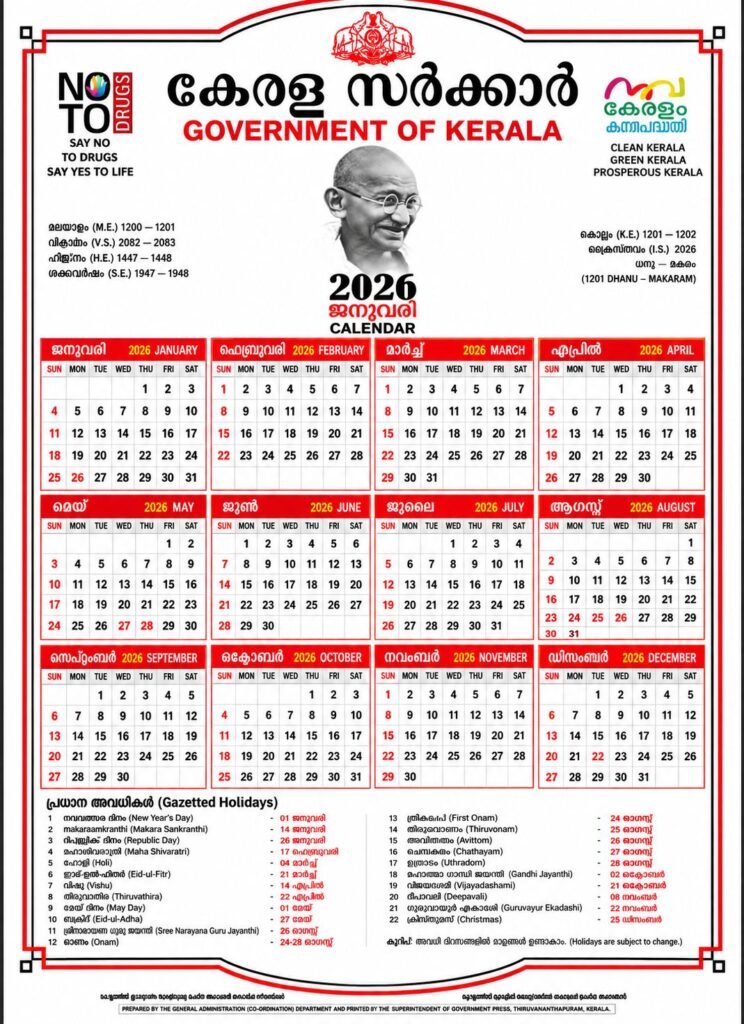
Download Malayalam Calendar 2026 PDF (Free)
We understand that scrolling through a website every time you need a date is not convenient. That is why a printable Malayalam Calendar 2026 PDF is available for free download. The PDF version covers all 12 months, festival dates, Ekadashi and vrat days, and marriage muhurat dates in one single file, so you can save it on your phone or print it out and keep it at home or your workplace. It is completely free to download, does not require any sign-up, and is updated whenever there are corrections or additional details to add. We recommend checking back on this page occasionally, since panchang-based dates are sometimes revised by regional almanac publishers closer to the actual month.
Major Festivals and National Holidays in 2026
Here are the important festival and holiday dates to keep in mind through the year.
| Month | Festival / Occasion | Date (2026) |
|---|---|---|
| January | Makar Sankranti / Pongal | January 14 |
| January | Republic Day | January 26 |
| February | Maha Shivaratri | February 15 |
| March | Holi | March 4 |
| March | Ram Navami | March 27 |
| April | Vishu / Tamil New Year | April 14 |
| May | Buddha Purnima | May 1 |
| July | Guru Purnima | July 29 |
| August | Onam (Thiruvonam) | August 26 |
| August | Raksha Bandhan | August 28 |
| August | Independence Day | August 15 |
| September | Krishna Janmashtami | September 4 |
| September | Ganesh Chaturthi | September 14 |
| October | Gandhi Jayanti | October 2 |
| October | Dussehra / Vijayadashami | October 22 |
| November | Diwali / Deepavali | November 8 |
| November | Bhai Dooj | November 11 |
| November | Guru Nanak Jayanti | November 24 |
| December | Christmas | December 25 |
Kerala also observes a few state-specific holidays around Onam and Vishu that are not always listed in national calendars, so it’s worth checking your local Kerala government holiday list separately if you need it for work or school planning.
Ekadashi and Vrat Dates in 2026
Ekadashi falls twice a month and is considered an important fasting day in many Kerala households, especially those who follow Vaishnavite traditions. Here are the key vrat dates through 2026.
| Month | Ekadashi / Vrat | Date (2026) |
|---|---|---|
| January | Saphala Ekadashi | January 10 |
| January | Putrada Ekadashi | January 25 |
| February | Jaya Ekadashi | February 8 |
| March | Amalaki Ekadashi | March 15 |
| March | Papmochani Ekadashi | March 29 |
| April | Kamada Ekadashi | April 13 |
| April | Varuthini Ekadashi | April 27 |
| May | Mohini Ekadashi | May 13 |
| May | Apara Ekadashi | May 27 |
| June | Nirjala Ekadashi | June 25 |
| July | Devshayani Ekadashi | July 25 |
| August | Shravana Putrada Ekadashi | August 23 |
| August | Varalakshmi Vrat | August 28 |
| September | Aja Ekadashi | September 7 |
| October | Papankusha Ekadashi | October 6 |
| October | Karwa Chauth | October 29 |
| November | Devutthana Ekadashi | November 5 |
| November | Ahoi Ashtami | November 1 |
| December | Mokshada Ekadashi | December 4 |
| December | Saphala Ekadashi | December 20 |
Along with Ekadashi, most months also have a Pradosh Vrat and Sankashti Chaturthi, which fall roughly twice and once a month respectively. These are widely observed for the well-being of the family and are usually timed around sunset or moonrise.
Marriage Muhurat Dates 2026
If you are planning a wedding in 2026, here are some of the auspicious dates traditionally considered favourable across the year. Always confirm these with your family priest, since muhurat also depends on the couple’s individual birth charts (janma kundli).
| Month | Suggested Muhurat Dates |
|---|---|
| January | 14, 23, 25, 28 |
| February | 3, 6, 9, 12–13, 19–20, 26 |
| March | 2, 3, 4, 7, 8, 9, 11, 12 |
| April | 15, 20, 21, 25–29 |
| May | 1, 3, 5–8, 13, 14 |
| June | 21–27, 29 |
| July | 1, 6, 7, 11 |
| August | 1, 12, 15 |
| September | 2, 20, 24 |
| October | 1, 3, 16, 25 |
| November | 20, 25–26 |
| December | 2–4, 12 |
Notice that there are very few or no muhurat dates listed for parts of the year — this is common, since certain periods like Chaturmas (roughly July to November in some traditions) are generally avoided for weddings.
Understanding Sankramam — The Foundation of Malayalam Months
Every Malayalam month begins on what is called a Sankramam — the exact day the sun moves from one zodiac sign into the next. There are 12 Sankramams in a year, one for each month, and they form the backbone of how the entire Malayalam Calendar is structured.
Because these transitions are tied to the sun’s actual position rather than a fixed calendar date, the start of a Malayalam month can shift by a day here and there compared to the previous year. This is normal and is accounted for in traditional panchang calculations every year.
Vishu 2026 — The Malayalam New Year
Vishu, falling on April 14, 2026, is considered the astrological new year in Kerala, even though the Malayalam calendar year technically starts later, in Chingam (August). On the morning of Vishu, families arrange a set of auspicious items — usually rice, fruits, flowers, gold, and a mirror — in front of an idol of Lord Krishna. This arrangement is called the Vishu Kani, and it is traditionally the first thing family members see when they wake up, believed to set the tone for good fortune through the year.
Another well-loved custom is Vishukkaineetam, where elders in the family give money to children and younger relatives as a blessing. Vishu also marks the traditional start of the harvest season in many parts of Kerala.
Onam 2026 — Kerala’s Grand Harvest Festival
Onam is Kerala’s biggest and most widely celebrated festival, and in 2026 the celebrations run from Atham (August 20) to Thiruvonam (August 26), spanning ten days in total. Onam celebrates the mythical homecoming of King Mahabali, a ruler remembered for his generosity and fairness.
Homes across Kerala are decorated with Pookalam, intricate floral carpets laid out at the entrance, and families come together for the Onam Sadya, a grand vegetarian feast served on banana leaves with over a dozen dishes. Boat races, particularly the famous Vallam Kali, and traditional dance forms like Thiruvathira are also an important part of the celebrations in many districts.
What Is the Malayalam Calendar?
The Malayalam Calendar, also called the Kollavarsham calendar, is the traditional calendar followed in Kerala. Unlike most Indian calendars that follow the moon’s phases, the Malayalam Calendar is a solar calendar. This means a new Malayalam month begins when the sun moves from one zodiac sign to another, not when the moon changes phase.
This is one reason why festivals like Onam always fall in the same season every year, while festivals that follow the lunar calendar, like Diwali, shift between October and November depending on the year.
The Malayalam year 2026 corresponds to Kollavarsham 1201–1202, since the Malayalam Era began around 825 years before the Gregorian calendar we use today. The Malayalam new year itself does not start on January 1; it usually begins around mid-June with the month of Chingam, though the astrological new year is celebrated earlier, at Vishu.
How Is the Malayalam Calendar Different From the Hindu Panchang?
Many people confuse the Malayalam Calendar with the general Hindu Panchang, but there are a few clear differences:
- Type of calendar: The Malayalam Calendar is purely solar. The Hindu Panchang used in most of North India is lunisolar, combining both the sun and the moon.
- Festival timing: Because it is solar, Onam always falls in August–September. Diwali, which follows the lunar Hindu calendar, can fall anywhere from mid-October to mid-November.
- New Year: The Malayalam new year begins around mid-June (Chingam 1), while most North Indian Hindu calendars begin their new year around March–April, close to Chaitra Navratri.
- Use in Kerala: Along with religious dates, the Malayalam Calendar is still commonly used in Kerala for auspicious timings, land agreements, and traditional ceremonies.
How to Use This Calendar in Daily Life
You don’t need to be deeply religious to find this calendar useful. Many families refer to it for:
- Choosing a good day to start a new job, business, or move into a new home
- Planning family functions, engagements, and weddings around suitable muhurat dates
- Keeping track of fasting days for personal or family religious practice
- Simply knowing when Kerala’s public holidays and festivals fall, for travel and leave planning
Keeping the downloadable PDF handy means you always have this information available, even without internet access.
Frequently Asked Questions
1. What is the Malayalam Calendar based on? It is based on the movement of the sun through the 12 zodiac signs, which is why it is called a solar calendar, unlike the lunar-based Hindu Panchang used in many other parts of India.
2. When does the Malayalam new year begin? The Malayalam calendar year (Kollavarsham) begins around mid-June with the month of Chingam, though Vishu in April is celebrated as the astrological new year.
3. Why does Onam always fall around the same time every year? Because Onam follows the solar Malayalam calendar, its date stays fairly fixed to August–September, unlike lunar festivals such as Diwali, which shift each year.
4. Is the Malayalam Calendar the same across Kerala? The core structure is the same, but minor variations in exact timings can appear between different panchang publishers, such as Mathrubhumi and Manorama calendars, due to slightly different calculation methods.
5. Can I rely on this calendar for fixing a wedding date? This calendar is a good starting reference, but for weddings and other major ceremonies, it’s best to have the final muhurat confirmed by a family astrologer, since it also depends on the birth details of the individuals involved.
6. Is the Malayalam Calendar 2026 PDF free to download? Yes, the PDF is completely free and does not require registration. It includes all months, festivals, vrat dates, and marriage muhurats for 2026.
Conclusion
The Malayalam Calendar 2026 brings together everything Kerala families look for in one place — monthly listings, festival dates, Ekadashi and vrat days, and marriage muhurat dates. Whether you’re planning a wedding, keeping a fast, or simply want to stay updated on Kerala’s festivals and holidays, this guide and the downloadable PDF should serve as a handy year-round reference. Do bookmark this page, as we review and update it whenever there are changes to reported dates.