If you are searching for the Malayalam calendar 2027 January, this guide gives you a clear, day-by-day view of the month, the major festivals, the vratams observed by Kerala families, and simple ways to bring those observances into your home without confusion or complexity.
January 2027 is a month of transition in the Malayalam calendar. It begins in the final days of Dhanu and moves into Makaram on 15 January 2027. That shift carries special meaning because Makaram is tied to the Makara Sankranti period, the northward journey of the sun, and the closing phase of the Sabarimala pilgrimage season. The month also includes two Ekadashi vratams, two Pradosham days, Amavasya, Pournami, and the important Kerala observance of Thaipuyam.
Below is a complete table of January 2027, followed by practical explanations of each major day and how Kerala families traditionally observe them at home.
January 2027 Malayalam Calendar: Day-by-Day Table
A note on dates: Tithi-based observances such as Ekadashi, Pradosham, and Pournami depend on the time of sunrise, moonrise, or the prevailing tithi in the local Kerala Panchangam. Nakshatra-based days such as Thaipuyam follow the star period. Families in Kochi, Thrissur, Palakkad, Kozhikode, or any other district should always cross-check with the Panchangam traditionally followed in their household or local temple.
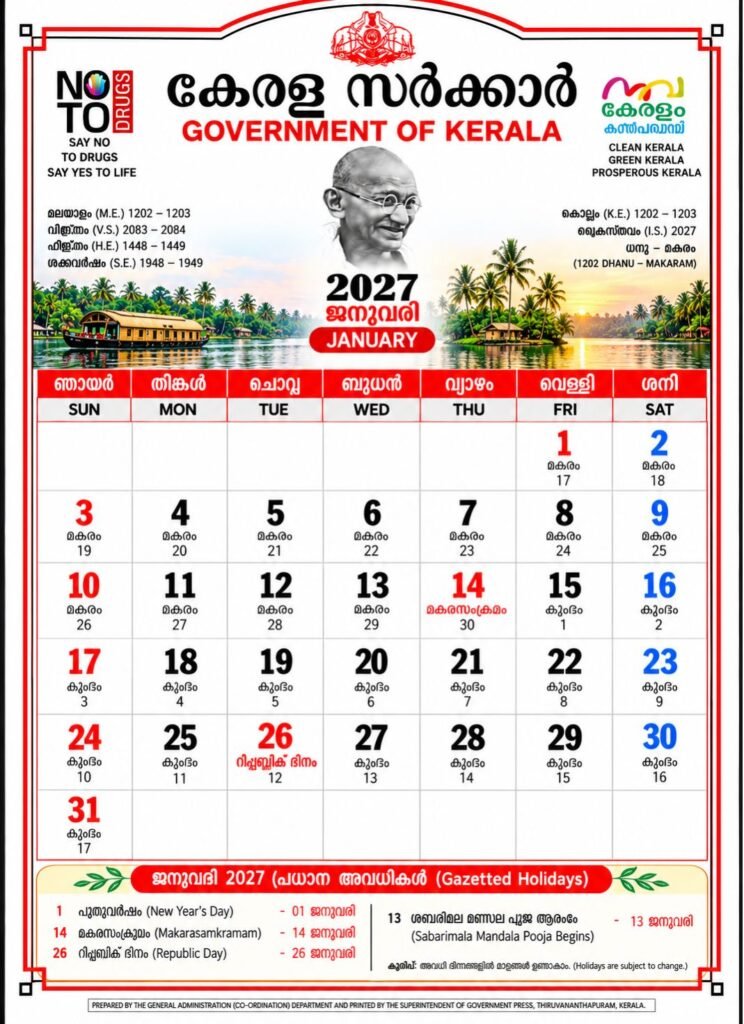
New Year’s Day and Mannam Jayanthi: A Gentle Start to January
January 1 is New Year’s Day, and in Kerala it is marked with family gatherings, new clothes, and visits to temples or churches according to family tradition. It is not a traditional Malayalam festival in the strict sense, but it has become a cultural reset day across the state. Many families begin the year with a simple prayer at home, a lamp lit before the family deity, and a shared meal.
The very next day, 2 January 2027, is Mannam Jayanthi, a Kerala public holiday that honours Mannathu Padmanabhan, the social reformer and founder of the Nair Service Society. For many Malayalis, this is a day of remembrance and community service rather than elaborate household ritual. If you are new to the Malayalam calendar, Mannam Jayanthi is a good reminder that the calendar is not only about fasting and festivals; it also carries Kerala’s social and cultural history.
Saphala Ekadashi on 3 January 2027: A Vishnu Vratam
The first major vratam of the month is Saphala Ekadashi on Sunday, 3 January 2027. Ekadashi is the eleventh tithi of the lunar fortnight, and in Kerala Vaishnava households it is dedicated to Lord Vishnu. The name “Saphala” means “fruitful,” and the day is traditionally associated with prayers for success and the removal of obstacles.
Kerala families observe Ekadashi in different ways. Some members fast completely, while others take fruit, milk, or a single simple meal without rice and grains. Onion, garlic, meat, and alcohol are commonly avoided. The important principle is that health comes first. A devotee who cannot fast fully can still participate through prayer, charity, and self-restraint.
A simple home observance for Saphala Ekadashi looks like this: bathe early, clean the pooja area, light a nilavilakku, offer tulasi leaves, flowers, fruit, and clean water before a picture or idol of Vishnu or Krishna. Chant “Om Namo Narayanaya” or recite a short Vishnu prayer familiar to your family. Complete the worship with deeparadhana and share prasadam. Many households also visit a nearby Vishnu or Krishna temple in the morning or evening.
Pradosham and Masa Shivaratri on 5 January 2027
5 January 2027 is a Tuesday and carries two Shiva-related observances: Pradosham and Masa Shivaratri. Pradosham is the thirteenth tithi of the lunar fortnight and is observed during the twilight period. Masa Shivaratri is the monthly Shivaratri, a quieter but equally meaningful day for Shiva devotees.
In Kerala, Pradosham is often observed with an evening visit to a Shiva temple, where devotees attend abhishekam or Pradosha pooja. At home, the observance is simple. Clean the prayer space, light a lamp, offer water to a Shiva lingam if your household practice permits, place bilva leaves and flowers, and chant “Om Namah Shivaya.” A vegetarian diet is customary, and many families fast until the evening worship or take only fruit and one light meal.
A second Pradosham falls on 20 January 2027, giving Shiva devotees another opportunity for evening prayer and reflection. The two Pradoshams in one Gregorian month are not unusual because the lunar calendar moves at its own pace.
Amavasya on 7 January 2027: New Moon and Ancestral Remembrance
7 January 2027 is Amavasya, the new moon day. In Kerala, Amavasya is associated with ancestral remembrance and offerings to family ancestors. The observance is usually quiet and home-centred. Many families light a lamp, offer simple food, and remember departed relatives with respect. It is not a day of loud celebration but of gratitude and continuity.
For families following the Malayalam calendar closely, Amavasya is also a day to keep routines simple. Some devotees avoid auspicious beginnings on this day and prefer prayer, charity, or quiet family time.
Makaravilakku on 14 January 2027 and Makaram 1 on 15 January 2027
The middle of January is the spiritual heart of the Malayalam calendar. 14 January 2027 is Makaravilakku, the central observance of the Sabarimala pilgrimage season. On the same night, the Makarajyothi is sighted at Ponnambalamedu, and the Thiruvabharanam procession reaches the Sabarimala temple. For Ayyappa devotees, this is the culmination of weeks of vratham, and for many Kerala families it is a day of vegetarian food, lamp worship, and the chanting of “Swamiye Saranam Ayyappa.”
The very next day, 15 January 2027, is Makaram 1, the first day of the Malayalam month of Makaram. It is also observed as Makara Sankranti, the day the sun enters the sidereal sign of Makara (Capricorn). In Kerala, Makaram 1 is traditionally connected with the northward journey of the sun, and it is considered an auspicious day for new beginnings, temple visits, and family prayers.
A simple home observance for Makaravilakku and Makaram 1 can include an early bath, a clean altar, a nilavilakku, offerings of coconut, banana, and flowers, and the family chanting Ayyappa prayers together. Families who cannot travel to Sabarimala often visit a nearby Ayyappa temple or conduct a short pooja at home. The emphasis in Kerala household practice is simplicity and discipline, not the replication of temple-only rituals.
Pausha Putrada Ekadashi on 19 January 2027
The second Ekadashi of the month is Pausha Putrada Ekadashi on Tuesday, 19 January 2027. This Ekadashi is also dedicated to Lord Vishnu, and the name “Putrada” is traditionally associated with prayers for children and family well-being. As with Saphala Ekadashi, the observance involves fasting or simple food, Vishnu prayers, and the lighting of a nilavilakku.
In Kerala, some families follow the Smarta tradition and observe the vratam on 18 January, while Vaishnava families may observe it on 19 January. The difference is not a contradiction; it reflects the way different Panchangam traditions calculate the tithi. For a household, the safest approach is to follow the Panchangam used by the family’s own temple or guru.
Pournami Vratham on 22 January 2027
22 January 2027 is Pournami, the full moon day. In Kerala, Pournami is observed with a simple vratam, lamp worship, and offerings of payasam or fruit. It is a gentle observance, and many families use it as a day of prayer and gratitude rather than strict fasting. The full moon is also linked to mental peace and family harmony in traditional Kerala thought, and the evening is often marked by a quiet pooja at home.
Thaipuyam on 23 January 2027: A Subrahmanya Observance
23 January 2027 is Thaipuyam (also written as Thaipusam), a day dedicated to Lord Subrahmanya, the son of Shiva and Parvati. In Kerala, Subrahmanya temples hold special abhishekam, archana, and processions according to local custom. The day is associated with the Pusam nakshatra, and devotees may keep a partial fast or eat one vegetarian meal.
A simple home observance includes cleaning the pooja room, lighting a nilavilakku, offering flowers, coconut, banana, and sandal paste before a picture of Lord Subrahmanya, and chanting “Om Saravanabhava.” Formal vows such as kavadi should be undertaken only with temple guidance. At home, a small serving of fruit or payasam is enough as prasadam.
Because Thaipuyam is nakshatra-based, the date can vary slightly between Panchangams. Some sources place it on 22 January, while Kerala Panchangams that follow the Pusam star period mark 23 January. Families should confirm with their local temple.
Republic Day and Martyrs’ Day: National Observances in the Malayalam Calendar
26 January 2027 is Republic Day, a national holiday in India. In Kerala, schools, offices, and community organisations hold flag-hoisting ceremonies and cultural programmes. 30 January 2027 is Martyrs’ Day, observed in remembrance of Mahatma Gandhi and others who gave their lives for the nation. These are not traditional Malayalam festivals, but they appear in Malayalam calendars because Kerala families observe them alongside the state’s spiritual and cultural rhythm.
How Kerala Families Use the January 2027 Malayalam Calendar at Home
The Malayalam calendar is most useful when it becomes a practical guide for daily life. Here are a few simple ways to use the January 2027 calendar in a Kerala household without turning it into a burden:
Keep a printed or digital copy in the pooja area. A single glance at the month helps families remember Ekadashi, Pradosham, and Pournami without last-minute confusion.
Check the local Panchangam for tithi timings. If a family wants to observe a vratam strictly, the Panchangam gives the correct sunrise, sunset, and moonrise times for the district. For most households, a simple sunrise-based observance is enough.
Use the calendar for meal planning. On Ekadashi and Pradosham days, many Kerala families prepare vegetarian meals without onion and garlic. Knowing the dates in advance makes shopping and cooking easier.
Treat the calendar as a family learning tool. Children can learn the Malayalam month names, the nakshatras, and the stories behind each festival. The calendar becomes a bridge between generations.
Balance tradition with health and work. Fasting should never come at the cost of health. Working professionals can observe Ekadashi with fruit and milk rather than a full fast. The spirit of the vratam is devotion and self-discipline, not rigidity.
Frequently Asked Questions About the Malayalam Calendar 2027 January
When does Makaram begin in 2027?
Makaram 1 falls on Friday, 15 January 2027.
When is Makaravilakku in 2027?
Makaravilakku is observed on Thursday, 14 January 2027.
How many Ekadashis are there in January 2027?
There are two: Saphala Ekadashi on 3 January and Pausha Putrada Ekadashi on 19 January.
When is Thaipuyam in Kerala in 2027?
Kerala Panchangams mark Thaipuyam on Saturday, 23 January 2027, based on the Pusam nakshatra period.
Are the dates the same for all districts in Kerala?
The dates are generally the same, but tithi and nakshatra timings can shift slightly depending on the district and the Panchangam followed. Families should confirm with their local temple or family Panchangam.
Conclusion
The Malayalam calendar 2027 January is a month that blends the quiet discipline of Ekadashi and Pradosham with the grand spiritual focus of Makaravilakku and the cultural warmth of Makaram 1. It is a month that invites Kerala families to slow down, light a lamp, offer a simple prayer, and stay connected to a calendar that has guided generations. Whether you are in Kerala or abroad, the dates in this guide give you a reliable starting point. Use them with respect for local tradition, keep health and family first, and let the calendar serve your spiritual life rather than complicate it.